
Titanium Grade 2, Sheet, Bar, Plate, AMS 4902 (CP Grade 2) - UNS R50400
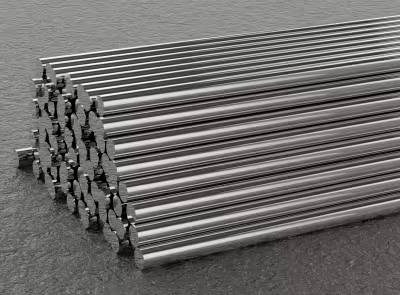
CP Grade 2 titanium is one of the most common titanium grades, with properties that make it a good candidate for chemical and marine, aerospace, and medical applications. Grade 2 is commercially pure, also referred to as CP, which means it is unalloyed. Grade 2 has higher levels of iron and oxygen than other CP grades, which offers excellent formability and moderate strength with superior corrosion resistance. This material has a minimum yield strength of 275 Mpa (40 ksi) and relatively low levels of impurity elements.
- Inventory & Specs
- Chemical Composition
- Physical Properties
- Mechanical Properties
- Datasheet
- Additional Info
- FAQs
Inventory Size Ranges for CP Grade 2
| Type | Size Range | AMS Standards | ASTM | UNS | Get a Quote |
|---|---|---|---|---|---|
| Coil | 0.016" - 0.125" | AMS 4902 | ASTM B 265, ASTM B 348, ASTM F 67 | UNS R50400 | Get a Quote |
| Sheet | 0.016" - 0.125" | AMS 4902 | ASTM B 265, ASTM B 348, ASTM F 67 | UNS R50400 | Get a Quote |
| Plate | 0.250" - 0.500" | AMS 4902 | ASTM B 265, ASTM B 348, ASTM F 67 | UNS R50400 | Get a Quote |
| Bar | 0.125" - 0.500" | AMS 4902 | ASTM B 265, ASTM B 348, ASTM F 67 | UNS R50400 | Get a Quote |
Advanced Inventory Size Ranges for CP Grade 2
| Type | Size Range | Specifications | Get a Quote |
|---|---|---|---|
| Build Platform | 0.500" - 5.000" | AMS 4902, ASTM B 265, ASTM B 348, ASTM F 67, UNS R50400 | Get a Quote |
| Feedstock | 1.37" - 5.90" | AMS 4942, AMS 4902, ASTM B348, UNS R50400 | Get a Quote |
Characteristics of CP Grade 2
The corrosion resistance of CP Grade 2 is based on the presence of a stable, continuous, tightly adherent oxide layer. This layer forms spontaneously and immediately upon exposure to oxygen. If damaged, it is able to readily reform as long as there is a source of oxygen in the environment. CP Grade 2 has relatively low impurity levels and is widely used due to its capability to perform well in many corrosion-critical applications such as marine environments and chemical processing. In seawater, this grade is fully resistant to corrosion at temperatures up to 600°F (315°C). This grade is fully resistant to stress-corrosion cracking in aqueous solutions and is largely immune to stress-corrosion cracking in general.
Working with CP Grade 2
CP Grade 2 can be hot worked, cold worked, and machined. When hot working, CP Grade 2 can be processed using conventional techniques such as hot rolling, forging, and hot pressing. Temperatures for initial roughing may be as high as 50-100°F (30-50°C) above the beta transus, and temperatures for finish processing typically range from 1500°F (815°C) to about 1650°F (900°C). CP Grade 2 has good ductility and can be formed at room temperature by various standard methods, including bending, stretch forming, heading, stamping, and drawing. This grade work hardens fairly rapidly, which is a limitation in some operations, such as cold drawing. The machining characteristics of CP Grade 2 are similar to those of austenitic stainless steels. In general, low cutting speeds, heavy feed rates, and copious amounts of cutting fluid are recommended when working with CP Grade 2. Because of the strong tendency of titanium to gall and smear, feeding should never be stopped while the tool and workpiece are in moving contact.
Other industry standards we comply with:
- DFARS Compliant
Common Trade Names
- Grade 2 Titanium
- Gr. 2 Titanium
- CP 2 Titanium
Industry Applications for CP Grade 2
- Airframe Skins, Ductwork, Brackets, Galley Equipment
- Chemical Processing Condensers, Evaporators, Reaction Vessels
- Desalinization Plant Tubing and Tube Heaters
- Cryogenic Vessels
- Heat Exchangers
- Electroplating
- Gaskets
- Medical Devices
Chemical Composition
| Element | Min | Max | |
|---|---|---|---|
| N | Nitrogen | - | 0.03 |
| C | Carbon | - | 0.10 |
| O | Oxygen | - | 0.25 |
| Fe | Iron | - | 0.30 |
| H | Hydrogen | - | 0.0155 |
| Ti | Titanium | - | Balance |
| - | Other | - | 0.4 |
Physical Properties
| Physical Property | T (°F) | T (°C) | Value | Value (SI) |
|---|---|---|---|---|
| Density | - | - | 0.1630 lb/in³ | 4.512 g/cm3 |
| Beta Transus | 1650-1700 | 899-927 | - | - |
| Melting (liquidus) Point | 3020-3040 | 1660-1671 | - | - |
| Specific Heat | 73 | 23 | 0.1250 Btu/°F | - |
| Electrical Resistivity | 104 | 40 | 294.8 μΩ∙in | 7.5 μΩ∙m |
| 210 | 99 | 24.0 μΩ∙in | .61 μΩ∙m | |
| 606 | 319 | 39.4 μΩ∙in | 1.0 μΩ∙m | |
| Modulus of Elasticity | - | - | 15.0 x 10³ ksi | 10.3 x 10⁴ MPa |
Mechanical Properties
Typical mechanical properties for CP Grade 2 titanium have an approximate Fatigue Limit Range for Smooth Axial Fatigue of R=0.1 - 275-345Mpa (40-50 ksi).
| Room Temperature Mechanical Properties | UTS, ksi (MPa) | YS, ksi (MPa) | % EI | %RA |
|---|---|---|---|---|
| Specified Minimum Properties | 50 (345) | 40 (275) | 20 | 30 |
| Typical Properties | 74-88 (510-605) | 49-79 (335-545) | 21-29 | 47-54 |
Datasheet
Additional Info
A Brief History of CP Grade 2
Commercially Pure (CP) Grade 2 Titanium is one of the most widely used unalloyed titanium grades, valued for its excellent balance of corrosion resistance, strength, and formability. As titanium production became commercially viable in the mid‑20th century, CP Grade 2 quickly emerged as a preferred material for industrial and aerospace applications requiring lightweight, corrosion‑resistant performance without the added complexity of alloyed titanium grades. Its reliable properties and broad availability helped establish titanium as a practical alternative to stainless steels and nickel‑based alloys in aggressive service environments.
How CP Grade 2 Was Developed
CP Grade 2 Titanium was developed through advances in titanium refining and melting technology that enabled the production of high‑purity material with controlled oxygen and iron content. Unlike alloyed titanium grades that rely on aluminum or vanadium for strength, CP Grade 2 achieves its mechanical properties primarily through its controlled chemistry and microstructure. This results in moderate strength combined with excellent ductility, weldability, and corrosion resistance.
By carefully limiting interstitial elements, metallurgists created a material that offered superior resistance to a wide range of corrosive media while remaining easy to fabricate and join. These characteristics made CP Grade 2 an attractive choice for applications where corrosion resistance and reliability outweighed the need for maximum strength.
Early Applications of CP Grade 2
Early adoption of CP Grade 2 Titanium was driven by industries requiring materials capable of withstanding aggressive chemical environments without excessive weight or maintenance. The alloy found widespread use in chemical processing equipment such as heat exchangers, tanks, piping, and pressure vessels, where conventional steels were prone to corrosion and contamination.
CP Grade 2 was also adopted in early aerospace and marine applications, where its excellent resistance to saltwater corrosion and favorable strength‑to‑weight ratio provided clear advantages over traditional materials. Its biocompatibility further led to early use in medical and dental applications.
How CP Grade 2 Is Used Today
Today, CP Grade 2 Titanium is a widely specified material across multiple industries due to its outstanding corrosion resistance, durability, and fabrication versatility. It is commonly used in:
- Chemical processing: Heat exchangers, reactors, vessels, piping, and linings
- Marine environments: Offshore components, seawater systems, and heat exchangers
- Aerospace: Non‑structural airframe components and ducting
- Medical and industrial applications: Equipment requiring biocompatibility and corrosion resistance
CP Grade 2 performs reliably across a broad temperature range and offers excellent resistance to chlorides, oxidizing environments, and many acids. Its combination of performance, availability, and cost effectiveness continues to make it a go‑to titanium grade where corrosion resistance and manufacturability are priorities.
Your Trusted Supplier for CP Grade 2
United Performance Metals is a global specialty metals solutions provider offering CP Grade 2 Titanium in coil, sheet, bar, and plate to support medical, aerospace, industrial, and chemical processing applications. With extensive titanium expertise, value‑added processing services, and strong supply‑chain support, UPM delivers materials that meet exact specifications and demanding quality requirements.
Contact our team today to learn how CP Grade 2 Titanium can support your next application.
Product FAQs
CP Grade 2 titanium is lightweight, easy to cold form, and is highly resistant to corrosion in oxidizing environments. This alloy provides biocompatibility and versatility and is best for environments with high corrosion, including airframes, ductwork, brackets, galley equipment, condensers, evaporators, and medical devices.