
Cobalt Chrome Molybdenum Bar Stock - Chrome Moly Steel - ASTM F1537 Alloy 1
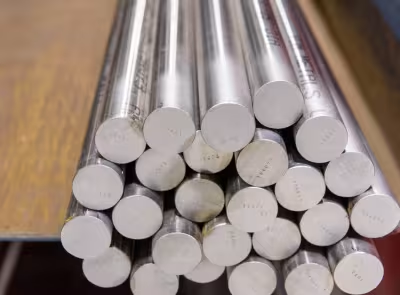
We are suppliers of Cobalt Chrome Molybdenum (ASTM F1537 Alloy 1) in round bar stock, sometimes known as chrome moly steel. This is a cobalt-chromium-molybdenum (Co-Cr-Mo) alloy used for machining and forging stock, especially in the medical implant industry. The molybdenum improves strength and heat resistance, while the chromium provides oxidation and corrosion resistance. Our CoCrMo bar stock (F1537 Alloy 1) is primarily used in the medical manufacturing industry, where its high fatigue life is appropriate for repeated movements found in joints like knees and hips. Biocompatibility is similar to titanium, with greater mechanical strength for load bearing applications. Our medical grade CCM steel bar is domestically melted and produced by a leading global US manufacturer and is universally accepted by all major medical OEMs.
- Inventory & Specs
- Chemical Composition
- Physical Properties
- Mechanical Properties
- Datasheet
- Additional Info
- FAQs
Inventory Size Ranges for Cobalt Chrome Moly
| Type | Size Range | ASTM | UNS | Get a Quote |
|---|---|---|---|---|
| Bar | 0.250" - 1.250" | ASTM F1537, ASTM F1537 Alloy #1 | UNS R31537 | Get a Quote |
Advanced Inventory Size Ranges for Cobalt Chrome Moly
| Type | Size Range | Specifications | Get a Quote |
|---|---|---|---|
| Powder | 15um - 53um | ASTM F75 | Get a Quote |
Characteristics of Cobalt Chrome Molybdenum (CCM)
CCM has high strength and hardness, even at elevated temperatures. This alloy also has high ductility and excellent fatigue resistance, which is especially important for load-bearing implants. CCM is known for its excellent corrosion resistance, especially with body fluids, chlorides, and oxidation at high temperatures. Its chromium content provides a strong passive oxide layer. CCM maintains strength and oxidation resistance at high temperatures, making it a useful tool for gas turbine manufacturing and engine components.
Working with Cobalt Chrome Molybdenum (CCM)
CCM has high hardness and wear resistance, requiring rigid setups and high-strength tooling for machining. Its low thermal conductivity also increases tool wear. CCM can be welded, but requires clean, oxide-free surfaces, controlled heat input, and filler metals that match its alloy chemistry. Avoid welding over plated or coated surfaces due to contamination risk. Cold working is the primary method for increasing the strength of CCM bar. Cold working is used to increase yield and tensile strength, improve fatigue resistance, and refine grain structure. Cold-worked CCM bar is commonly used for orthopedic implants and high-wear mechanical components. A standard production sequence looks like melting, forging or hot-working, cold drawing or cold work to final size, stress-relief heat treating, and finished machining.
Other industry standards we comply with:
Common Trade Names
- BioDur® Carpenter CCM® Alloy
- CarTech® BioDur® CCM® Alloy
Industry Applications for Cobalt Chrome Moly
- Acetabular Cups
- Knee replacements
- Hip replacement implants
- Shoulder replacement implants
- Spinal rods, cages and disc replacement
- Fracture fixation
Our medical grade CCM round bar is domestically melted and produced by a leading global US manufacturer and is universally accepted by all major medical OEMs.
Chemical Composition
| Element | Min | Max | |
|---|---|---|---|
| Co | Cobalt | - | 66.00 |
| Cr | Chromium | - | 27.0 |
| Ni | Nickel | - | 0.2 |
| Mo | Molybdenum | - | 5.5 |
| C | Carbon | - | 0.04 |
Physical Properties
| Property | Value |
|---|---|
| Density | 0.2990 lb/in |
| Poissons Ratio | 0.300 |
| Modulus of Elasticity | (E) 35.0 x 10³ ksi |
| Modulus of Rigidity | (G) 13.4 x 10³ ksi |
| Specific Gravity | 8.29 |
Mechanical Properties
| Condition | 0.2% Yield Strength | Ultimate Tensile Strength | % Elongation in 4D | % Reduction of Area | HRC Hardness |
|---|---|---|---|---|---|
Annealed | 85 ksi (585 MPa) | 150 ksi (1035 MPa) | 25 | 23 | 30 |
Warm Worked | 135 ksi (930 MPa) | 190 ksi (1310 MPa) | 26 | 23 | 40 |
Hot Worked | 110 ksi (760 MPa) | 160 ksi (1100 MPa) | 25 | 23 | 33 |
Additional Info
A Brief History of Cobalt Chrome Moly (CCM)
Cobalt‑chrome‑moly traces its origins to early 20th‑century metallurgy, when researchers were searching for metals that could outperform steel in corrosion resistance and high‑temperature strength. Over time, cobalt chrome moly evolved into one of the most durable and biocompatible materials used in medicine and engineering.
How CCM Was Developed
Metallurgists discovered that adding molybdenum to cobalt alloys improved high temperature strength, wear resistance, and hardness. This refinement produced the modern Co-Cr-Mo alloy family. As the alloy’s performance became recognized, formal specifications emerged, including ASTM F75 for cast Co‑Cr‑Mo and ASTM F799 and ASTM F1537 for wrought and forged forms. These standards ensured consistent chemistry and mechanical properties, especially for medical applications.
Early Applications of CCM
Before medical adoption, Co-Cr-Mo was used in cutting tools, turbine blades, and chemical processing equipment. A medical breakthrough occurred from the 1950s-1970s, and surgeons and biomaterials researchers recognized that Co-Cr-Mo offered excellent biocompatibility, resistance to body fluid corrosion, and exceptional wear resistance for articulating joints. This led to CCM being used for hip implants, knee components, dental prosthetics, bone plates, and screws. CCM quickly became one of the most trusted materials for long-term implants.
How CCM is Used Today
Today, CCM remains a leading material for hip and knee replacements, spinal implants, dental frameworks, trauma hardware, and wear-resistant joint surfaces. Its combination of strength, fatigue resistance, and biocompatibility make it ideal for load-bearing joints.
Your Trusted Supplier of Cobalt Chrome Moly Bar
United Performance Metals supplies CCM bar sizes 0.250" - 1.250". This product is ASTM F1537 certified Alloy #1. Get same or next day shipment from stock, mill quantities to blanket orders, FIRSTCUT+® Processing Services, comprehensive inventory management, and materials that are melt-source traceable when your work with UPM.
UPM Advanced Solutions stocks CCM powder for additive manufacturing in sizes ranging 15um - 53um. This product meets the ASTM F75 specification.
Product FAQs
CCM offers higher wear resistance, higher hardness, and better long-term articulation performance. Titanium offers lower weight, better osseointegration, and easier machining. Both are widely used in implants but for different roles.
Yes, CCM can be heat-treated but not for hardening. Heat treatment is used for stress relief, homogenization, and improving ductility. Strength is primarily controlled by cold work, not heat treatment.
Yes, CCM work-hardens quickly, has low thermal conductivity, and is naturally hard and abrasive, making it difficult to machine. Machining CCM requires rigid setups, sharp carbide tools, high‑pressure coolant, and controlled feeds and speeds.