
Alloy L605 Cobalt - AMS 5537, AMS 5759
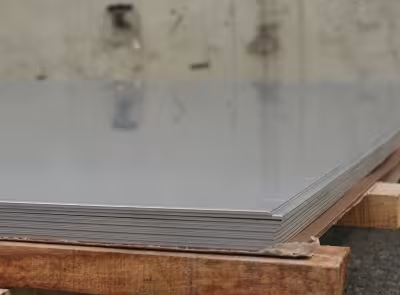
Udimet Alloy® L605 (AMS 5537, AMS 5759) is a cobalt-chromium-tungsten-nickel alloy. This product offers excellent high temperature strength and sulfidation resistance, good oxidation resistance up to 2000°F (1093°C), and good resistance to wear and galling. Originally developed for demanding aerospace and turbine environments, it maintains mechanical integrity in conditions that cause many alloys to soften, creep, or scale. Its remarkable resistance to wear, thermal fatigue, and corrosive combustion atmospheres has made it a trusted material for hot‑section turbine components, combustion liners, afterburner parts, and other mission‑critical hardware. L605’s combination of toughness, heat resistance, and long‑term durability continues to make it one of the most reliable cobalt alloys for extreme‑temperature service.
- Inventory & Specs
- Chemical Composition
- Physical Properties
- Mechanical Properties
- Datasheet
- Additional Info
- FAQs
Inventory Size Ranges for L605
| Type | Size Range | AMS Standards | UNS | Get a Quote |
|---|---|---|---|---|
| Coil | 0.032" - 0.065" | AMS 5537, AMS 5759 | UNS R30605 | Get a Quote |
| Sheet | 0.032" - 0.065" | AMS 5537, AMS 5759 | UNS R30605 | Get a Quote |
| Bar | 0.250" - 4.000" | AMS 5537, AMS 5759 | UNS R30605 | Get a Quote |
| Precision Reroll Strip | 0.0008" - 0.015" | Get a Quote |
Characteristics of alloy L605
L605 material feature excellent resistance to the hot corrosive atmospheres of jet engine applications, and its oxidation resistance is good for intermittent service up to 1600°F (871°C) and continuous service up to 2000°F (1093°C). L605 is especially resistant to carburizing and sulfidizing atmospheres up to 1600°F (871°C). These properties make it ideal for gas turbine applications, liners, combustion chamber components, and jet engine parts.
Working with alloy L605
This cobalt alloy features good fabricability, and it can be machined, welded, and formed through most standard methods. Welding using a submerged arc welding process is not recommended, but other methods like tungsten arc, shielded metal arc, and gas metal arc welding are acceptable. When welding, use minimum restraint and low interpass temperatures, with rapid cooling afterward. L-605 is very ductile, with good forming characteristics for both hot and cold working.
Other industry standards we comply with:
- B50TF26
- PWA-LCS
- GE Aircraft Engine (GT193)
- GE Aviation S-SPEC-35 AeDMS S-400
- RR SABRe Edition 2
- DFARS Compliant
Common Trade Names
- HAYNES® 25, L-605 Alloy
- Udimet Alloy L605 (® Special Metals)
- ATI L-605 (™ Allegheny Technologies)
Industry Applications for L605
- Aircraft engine combustor liners
- Jet engine and aerospace components
- Land based gas turbine combustor liners
- Industrial furnace lines
- Mufflers and liners for high temperature kilns
- High temperature ball bearings
- Marine turbines
Chemical Composition
| Element | Min | Max | |
|---|---|---|---|
| Co | Cobalt | - | Balance |
| Cr | Chromium | - | 20.00 |
| W | Tungsten | - | 15.00 |
| Ni | Nickel | - | 10.0 |
| Fe | Iron | - | 3.00 |
| Mn | Manganese | - | 1.50 |
| Si | Silicon | - | 0.40 |
| C | Carbon | - | 0.1 |
| S | Sulfur | - | 0.030 |
| P | Phosphorous | - | 0.040 |
Physical Properties
| Property | Value |
|---|---|
| Density | 0.330 lb/in3 (9.14 g/cm3) |
| Melting Range | 2375-2425°F (1300-1330°C) |
| Specific Heat | 0.097 at 70°F, Bru/lb°F (405 at 21°C J/kg°C) |
| Permeability | 1.0007 at 200 oersted |
| Coefficient of Expansion | 6.6 0-200°F, 10-6in/in°F |
| Thermal Conductivity | 84 Btu in/ft2 h °F W/wm °C |
| Electrical Resistivity | 613 ohm circ mil/ft (102 microhm-cm) |
Mechanical Properties
| Ultimate Tensile Min | Yield Strength Min (0.2% OS) | Elongation in 4D % | ||
|---|---|---|---|---|
| ksi | MPa | ksi | MPa | |
| 125 | 862 | 45 | 310 | 30 |
| Temperature | Rupture Strength | ||
|---|---|---|---|
| °F | °C | ksi | MPa |
| 1200 | 649 | 39 | 270 |
| 1300 | 704 | 32 | 220 |
| 1400 | 760 | 24 | 165 |
| 1500 | 816 | 17 | 120 |
| 1600 | 871 | 10 | 72 |
| 1700 | 927 | 6 | 44 |
| 1800 | 982 | 4 | 25 |
Datasheet
Additional Info
A Brief History of L605
Alloy L605 emerged as part of the mid‑20th‑century push to create high‑performance cobalt‑based superalloys capable of withstanding extreme temperatures and corrosive environments. Its long service history has made it one of the most extensively studied cobalt alloys, with decades of research documenting its behavior under a wide range of conditions.
How L605 Was Developed
L605 was engineered as a solid‑solution‑strengthened cobalt‑chromium‑tungsten‑nickel alloy. This composition was chosen to maximize high‑temperature strength, oxidation resistance, and durability. Developers aimed to create an alloy that could maintain mechanical integrity at temperatures exceeding 1800°F (980°C), resist sulfidation, and endure wear and galling. Because of its widespread adoption, L605 became one of the most thoroughly investigated cobalt alloys, with research exploring its performance across many thermal and mechanical conditions.
Early Applications of L605
Early use cases centered on industries requiring materials that could survive high heat and corrosive atmospheres:
- Aerospace: Hot‑section engine parts, combustion chambers, and afterburner components benefited from L605’s strength and oxidation resistance up to 1800–2000°F
- Industrial: Furnaces, heat‑treating equipment, and chemical processing systems used L605 for its resistance to oxidation, sulfidation, and wear
- Defense: Its durability and heat resistance made it suitable for early military propulsion and high‑stress mechanical systems
How L605 is Used Today
L605 remains relevant due to its unique combination of high‑temperature strength, corrosion resistance, and formability:
- Aerospace: Turbine engine components, exhaust systems, combustion liners
- Medical: Surgical implants, stents, biomedical components
- Power Generation: Gas turbine parts, chemical processing equipment, furnace hardware
Your Trusted Supplier of L605 Cobalt
United Performance Metals offers Alloy® L605 coil and sheet 0.032" - 0.065", bar 0.250" - 4.000", and precision reroll strip 0.0008" - 0.015". This product is commonly used for aerospace gas turbine engines, industrial furnaces, and other high temperature applications.
Product FAQs
L605 maintains strength at temperatures up to ~2150°F, has excellent oxidation and sulfidation resistance, has outstanding wear, galling, and fatigue resistance, is non-magnetic, and demonstrates good corrosion resistance in a wide range of environments.
L605 offers higher tensile and creep strength at elevated temperatures, better oxidation resistance, and superior wear and galling resistance compared to other cobalt alloys. It is offer chosen when both high-temperature strength and surface durability are required.
L605 is a solid‑solution‑strengthened alloy, so it does not rely on precipitation hardening. Heat treatment is typically used only to improve ductility or relieve stress.
L605 retains excellent mechanical strength and oxidation resistance up to approximately 1800–2150°F, making it suitable for hot‑section aerospace and industrial components.