
4340 Steel Build Platform - AMS 6359 - ASTM A829 - UNS G43400
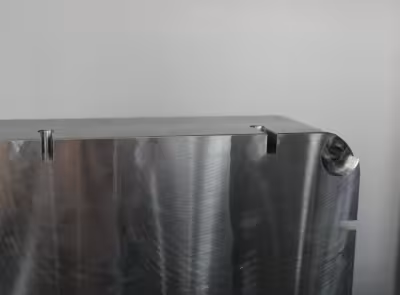
4340 steel plate (AMS 6359) is a premium, aircraft-quality nickel-chromium-molybdenum alloy steel engineered for exceptional toughness, deep hardenability, and superior fatigue strength. Its unique alloy composition allows it to maintain strength and hardness even at elevated temperatures, making it an ideal choice for critical structural components in high-stress environments. This grade is widely used in aerospace and defense applications where reliability and performance under extreme conditions are essential.
Supplied in annealed or heat-treated conditions, 4340 steel offers excellent machinability in the annealed state and can be quenched and tempered to achieve tensile strengths up to 260 ksi. This versatility enables manufacturers to tailor mechanical properties for specific requirements, ensuring durability and precision in demanding applications such as landing gear, turbine shafts, and heavy-duty industrial components. Its combination of strength, toughness, and adaptability makes 4340 a trusted material for industries that require uncompromising performance.
- Inventory & Specs
- Chemical Composition
- Physical Properties
- Mechanical Properties
- Additional Info
- FAQs
Advanced Inventory Size Ranges for 4340
| Type | Size Range | Specifications | Get a Quote |
|---|---|---|---|
| Build Platform | 0.500" - 5.000" | AMS 6359, ASTM A829, UNS G43400 | Get a Quote |
Ideal for Additive Manufacturing Build Platforms
In Powder Bed Fusion (PBF) systems, platform rigidity and thermal stability are critical for maintaining part integrity and dimensional accuracy. 4340 steel delivers exceptional strength, toughness, and deep hardenability, ensuring a stable surface through repeated thermal cycles and heavy build loads. Its ability to maintain hardness at elevated temperatures makes it an excellent choice for industries where precision, durability, and high performance are essential—such as aerospace, defense, energy, and advanced manufacturing applications.
Why Choose United Performance Metals?
At United Performance Metals, we manufacture 4340 Steel Build Platforms to exacting standards, offering:
- Superior Strength & Stability: Maintains flatness and structural integrity under extreme thermal and mechanical stresses.
- Heat-Treatable for Enhanced Hardness: Achieve tensile strengths up to 260 ksi for extended platform life.
- Excellent Machinability & Weldability: Enables precision finishing for optimal powder bed performance.
- Custom Sizes: Available to fit your specific PBF machine requirements.
Other industry standards we comply with:
Common Trade Names
- AISI 4340, E4340
Industry Applications for 4340
- Landing Gear
- Structural Fittings
- Engine Components
- Tooling Dies
- Turbine Shafts
Chemical Composition
| Element | Percent by Weight Min | Percent by Weight Max | |
|---|---|---|---|
| C | Carbon | 0.38 | 0.43 |
| Mn | Maganese | 0.60 | 0.85 |
| Si | Silicon | 0.15 | 0.35 |
| Cr | Chromium | 0.70 | 0.90 |
| Ni | Nickel | 1.65 | 2.00 |
| Mo | Molybdenum | 0.20 | 0.30 |
| P | Phosphorous | 0.025 | |
| S | Sulfur | 0.04 | |
| Fe | Iron | Balance | |
Physical Properties
| Property | Value |
|---|---|
| Density | 7.85 g/cm³ |
| Modulus of Elasticity | ~205 GPa |
| Thermal Expansion | 12.3 × 10⁻⁶ /°C |
| Thermal Conductivity | ~44 W/m·K |
| Poisson's Ratio | 0.29 |
Mechanical Properties
| Condition | Tensile (ksi) | Yield (ksi) | Hardness |
|---|---|---|---|
| Annealed | ~125 | ~100 | 235 HB max |
| Quenched & Tempered | 180–220 | 150–170 | 40–50 HRC |
| Through-Hardened | Up to 260 | ~217 | — |
Additional Info
A Brief History of 4340
4340 steel evolved alongside the broader development of alloy steels as industries sought materials with higher strength and durability than traditional carbon steels. Early alloy experimentation introduced elements like nickel, chromium, and molybdenum to improve toughness, hardenability, and wear resistance. These traits became defining characteristics of 4340.
How 4340 was Developed
4340 steel was engineered as a nickel‑chromium‑molybdenum low‑alloy steel, classified under the AISI/SAE system as a medium‑carbon alloy. Its composition was optimized to deliver exceptional strength, toughness, and fatigue resistance. Heat‑treatability became a key feature, allowing engineers to tailor mechanical properties for demanding applications.
Early Applications of 4340
Early industrial uses included high‑stress components where carbon steels were insufficient, such as heavy machinery parts, shafts, and fasteners. As alloy‑steel technology matured, 4340 became a preferred material for applications requiring both toughness and wear resistance, including early aerospace and defense components.
How 4340 is Used Today
4340 remains widely used due to its combination of strength, toughness, and fatigue resistance.
- Aerospace: Landing gears, structural components, high-strength fasteners
- Automotive: Drivetrain parts, crankshafts, gears
- Machinery: Shafts, axles, dynamically loaded parts
Your Trusted Supplier of 4340 Steel
UPM Advanced Solutions supplies 4340 build plates for powder bed fusion (PBF) additive manufacturing.
Product FAQs
4340 is a nickel‑chromium‑molybdenum alloy steel known for its high strength, toughness, and excellent fatigue resistance.
Its combination of high hardenability, deep heat‑treat response, and excellent toughness sets 4340 steel apart from many other alloy steels.
Yes, heat treatment is one of its biggest advantages. It can be normalized, quenched and tempered, austempered, and carburized. This allows engineers to tune hardness and toughness for specific applications.
With proper quench and temper, it can reach HRC 50+, though typical industrial applications use lower hardness to maintain toughness.
4340's nickel-rich alloy structure gives it exceptional toughness and fatigue resistance, so it resists warping, cracking, thread pull-out, and surface deformation. This makes 4340 more durable than many lower-alloy steels and a great choice for AM build plates.