
316 / 316L Stainless Steel Sheet, Coil & Bar - AMS 5524, 5507
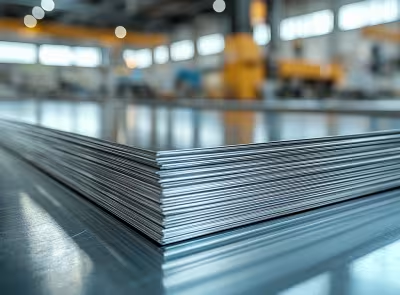
Type 316 stainless steel is austenitic steel that differs from grade 304 through the addition of molybdenum, which increases its resistance to chemical corrosion and marine environments. These materials excel in harsher atmospheres, where pitting and crevice corrosion can occur through chloride exposure or solvents used in processing. 316L stainless steel is an extra-low carbon version of 316 SS, and while both grades are very similar, 316 "L" is ideal for heavy gauge welding applications, as it is less susceptible to weld decay. The low carbon content decreases carbide precipitation that sensitizes the grain boundaries of welds in these materials. The austenitic structure of 316L provides excellent toughness even at cryogenic temperatures.
- Inventory & Specs
- Chemical Composition
- Physical Properties
- Mechanical Properties
- Datasheet
- Additional Info
- FAQs
Inventory Size Ranges for 316/316L
| Type | Size Range | AMS Standards | ASTM | UNS | ASME | Get a Quote |
|---|---|---|---|---|---|---|
| Coil | 0.010" - 0.125" | AMS 5524, AMS 5507 | ASTM A 167, ASTM A 240, ASTM F 138, ASTM F 899 | UNS S31600, UNS S31603 | ASME SA 167, ASME SA2 40 | Get a Quote |
| Sheet | 0.010" - 0.125" | AMS 5524, AMS 5507 | ASTM A 167, ASTM A 240, ASTM F 138, ASTM F 899 | UNS S31600, UNS S31603 | ASME SA 167, ASME SA2 40 | Get a Quote |
| Bar | 0.250" - 6.250" | AMS 5524, AMS 5507 | ASTM A 167, ASTM A 240, ASTM F 138, ASTM F 899 | UNS S31600, UNS S31603 | ASME SA 167, ASME SA2 40 | Get a Quote |
| Precision Reroll Strip | 0.0008" - 0.015" | Get a Quote |
Advanced Inventory Size Ranges for 316/316L
| Type | Size Range | Specifications | Get a Quote |
|---|---|---|---|
| Build Platform | 0.500" - 5.000" | AMS 5507, ASTM A167 | Get a Quote |
| Feedstock | 1.37" - 5.90" | AMS 5648, ASTM A276/A479, UNS S31600 | Get a Quote |
| Powder | 15um - 106um | ASTM F3184 | Get a Quote |
Characteristics of 316/316L
Both grade 316 and 316L steels offer high creep strength, stress-to-rupture and tensile strength at high temperatures, as well as excellent corrosion resistance and strength properties. Annealing, or heat treating, can be done between 1,900 – 2,100°F (1,038 to 1,149°C), and is commonly used to restore corrosion resistance in heavily welded 316 steel materials. The annealed austenitic stainless steels maintain a high level of impact resistance even at cryogenic temperatures, a property which, in combination with their low temperature strength and fabricability, has led to their extensive use in cryogenic applications.
Working with 316/316L
Heat treatment may be necessary during or after fabrication to remove the effects of cold forming or to dissolve precipitated chromium carbides resulting from thermal exposures. The solution anneal is accomplished by heating in the 1900-2150°F (1040-1175°C) temperature range followed by air cooling or a water quench, depending on section thickness. Cooling should be sufficiently rapid through the 1500-800°F (816-427°C) range to avoid re-precipitation of chromium carbides and provide optimum corrosion resistance. In every case, the metal should be cooled from the annealing temperature to black heat in less than three minutes.
The excellent ductility of the austenitic alloys allows them to be readily formed by bending, stretching, deep drawing and spinning. However, because of their greater strength and work harden-ability, the power requirements for the austenitic grades during forming operations is considerably greater than for carbon steels. Attention to lubrication during forming of the austenitic alloys is essential to accommodate the high strength and galling tendency of these alloys.
The austenitic stainless steels are considered to be the most weldable of the stainless steels. They are routinely joined by all fusion and resistance welding processes. Two important considerations for weld joints in these alloys are: (1) avoidance of solidification cracking, and (2) preservation of corrosion resistance of the weld and heat-affected zones.
Other industry standards we comply with:
- PWA-LCS
- GE Aircraft Engine (GT193)
- GE Aviation S-SPEC-35 AeDMS S-400
- RR SABRe Edition 2
- DFARS Compliant
Common Trade Names
- ATI 316L (™ Allegheny Technologies)
- ATI 316 (™ Allegheny Technologies)
Industry Applications for 316/316L
- Oil & petroleum refining equipment
- Aerospace structures
- Stainless steel base plates
- Food processing equipment
- Pulp and paper processing equipment
- Soap and photographic handling equipment
- Textile industry equipment
- Architectural
- Pharmaceutical processing equipment
Chemical Composition
| | Element | Min | Max |
|---|---|---|---|
| C | Carbon | - | 0.08 |
| Mn | Manganese | - | 2.00 |
| Si | Silicon | - | 0.75 |
| Cr | Chromium | 16.00 | 18.00 |
| Ni | Nickel | 10.00 | 14.00 |
| Mo | Molybdenum | 2.00 | 3.00 |
| P | Phosphorus | - | 0.045 |
| S | Sulfur | - | 0.030 |
| N | Nitrogen | - | 0.10 |
| Fe | Iron | - | Balance |
| | Element | Min | Max |
|---|---|---|---|
| C | Carbon | - | 0.030 |
| Mn | Manganese | - | 2.00 |
| Si | Silicon | - | 0.75 |
| Cr | Chromium | 16.00 | 18.00 |
| Ni | Nickel | 10.00 | 14.00 |
| Mo | Molybdenum | 2.00 | 3.00 |
| P | Phosphorus | - | 0.045 |
| S | Sulfur | - | 0.030 |
| N | Nitrogen | - | 0.10 |
| Fe | Iron | - | Balance |
Physical Properties
| Property | Value |
|---|---|
| Density | 0.29 lb/in3 (8.027 g/cm3) |
| Modulus of Elasticity in Tension | 29 x 106 psi (200GPa) |
| Melting Range | 2540-2630°F (1390-1440°C) |
| Modulus of Shear | 11.9 x 10⁶ psi (82 GPa) |
| Magnetic Permeability | H/m Annealed 1.02 Max @ 200 H |
| Temperature Range | Mean Coefficient of Thermal Expansion | ||
|---|---|---|---|
| °C | °F | cm/cm/°C | in/in/°F |
| 20 - 100 | 68-212 | 16.5 · 10-6 | 9.2 · 10-6 |
| 20 - 500 | 68-932 | 18.2 · 10-6 | 10.1 · 10-6 |
| 20 - 1000 | 68-1832 | 19.5 · 10-6 | 10.8 · 10-6 |
| Temperature Range | W/m · K | Btu/(hr/ft²/in/°F) | |
|---|---|---|---|
| °C | °F | ||
| 20-100 | 68-212 | 14.6 | 100.8 |
| °C | °F | J/kg °K | Btu/lb/°F) |
|---|---|---|---|
| 20 | 68 | 450 | 0.108 |
| 93 | 200 | 450 | 0.116 |
| Type | Value at 68°F (20°C | |
|---|---|---|
| Microhm-cm | Microhm-in. | |
| 316 | 29.1 | 74.0 |
Mechanical Properties
| Property | Type 316 (S31600) | Type 316L (S31603) | Type 317 (S31700) | Type 317L (S31703) |
|---|---|---|---|---|
| Yield Strength 0.2% Offset psi MPa | 30,000 205 | 25,000 170 | 30,000 205 | 30,000 205 |
| Ultimate Tensile Strength psi MPa | 75,000 515 | 70,000 485 | 75,000 515 | 75,000 515 |
| Percent Elongation in 2 in. or 51mm | 40.0 | 40.0 | 35.0 | 40.0 |
| Hardness, Max. Brinell RB | 217 95 | 217 95 | 217 95 | 217 95 |
Datasheet
Additional Info
A Brief History of 316/316L Stainless Steel
316 stainless steel emerged in the early‑to‑mid 20th century as industries began demanding stainless alloys that could survive chloride‑rich, corrosive, and marine environments. Standard 304 stainless was excellent for general corrosion resistance, but it struggled with pitting corrosion, crevice corrosion, and chloride attack, especially in seawater and chemical processing. To address these failures, metallurgists introduced molybdenum into the 300‑series austenitic stainless family. This addition created what we now know as Type 316, the first widely used “moly‑bearing” stainless steel. 316L followed shortly after as a low‑carbon variant designed to improve weldability and prevent carbide precipitation in welded structures.
How 316/316L Was Developed
Metallurgists wanted a stainless steel that could outperform 304 in environments contain chlorides, acids, salts, high humidity, and marine exposure. The key was adding 2-3% molybdenum, which dramatically improved pitting resistance, crevice corrosion resistance, high temperature strength, and resistance to chemical attack. 316L was developed by lowering carbon content to ≤0.03%, which prevents chromium carbide precipitation during welding, improves corrosion resistance in the heat-affected zone, and eliminates the need for post-weld annealing in most cases.
Early Applications of 316/316L
316 and 316L quickly became essential in industries where 304 simply wasn’t enough. Early applications included marine hardware, chemical processing equipment, food and pharmaceutical vessels, pulp and paper processing, medical instruments, heat exchangers and condensers, and industrial piping systems.
How 316/316L is Used Today
316 and 316L remain two of the most important stainless steels in modern manufacturing. Their combination of corrosion resistance, weldability, and cleanliness makes them indispensable.
- Medical & Pharmaceutical: Surgical tools, sanitary tubing, tanks
- Food & Beverage: Food and beverage storage and piping
- Oil & Gas: Seawater piping, components exposed to chlorides and corrosive fluids
- Chemical Processing: Tanks, valves, pumps, heat exchangers
Your Trusted Supplier of 316/316L
United Performance Metals offers 316/316L stainless steel coil and sheet 0.010" - 0.125", bar 0.250" - 6.250", and precision reroll strip 0.0008" - 0.015". These grades are well suited for fabricated or formed applications like refining equipment, surgical tools, fasteners, pulp and paper processing equipment, and pharmaceutical processing.
Product FAQs
316L has lower carbon than standard 316. This gives 316: better weldability, lower risk of carbide precipitation, and better corrosion resistance in welded structures. Mechanical strength is slightly lower in 316L, but the difference is usually undetectable in real-world use.
No, like all austenitic stainless steels, 316/316L cannot be hardened by heat treatment. Strength increases can only come through cold-working.
315 provides better chloride resistance, better acid resistance, and better performance in marine environments. 304 is fine for general use, but 316 is chosen when corrosion risk is higher.